Discipline guide
Surf apnea training
What breath training does for surfers, what it cannot do, and why it is taught the way it is.
Most surfers meet apnea training after a scare: a hold-down that lasted longer than expected, a wipeout that emptied the tank. This guide explains what the training actually develops, the honest limits of breath work, and how it fits into preparing for demanding water — written by the team that teaches it.
One discipline, two honest questions
What this guide covers
Surf apnea training has picked up a mystique — and some marketing that oversells it. We teach it as one part of a preparation program, so this page answers the two questions that matter: what the training genuinely develops, and what it cannot do for you. For the full program it sits inside, read the big-wave training guide.
What surf apnea training is
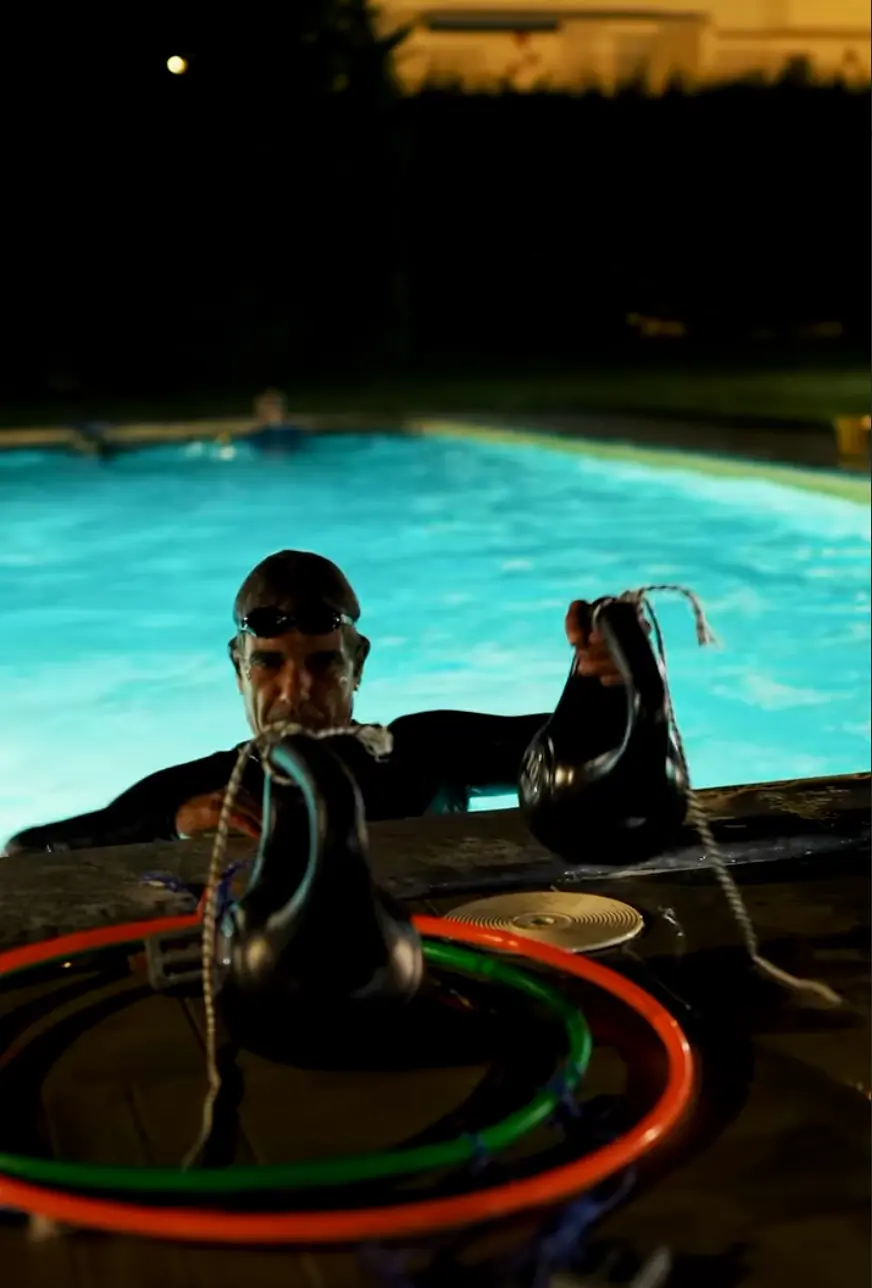
Surf apnea training adapts breath-hold methods to the specific demands of surfing. The urge to breathe that builds during a hold-down is driven mainly by rising carbon dioxide, not falling oxygen — which is why the training works on CO₂ tolerance and relaxation rather than on maximum static breath-holds.
The physiology backs a cautious approach: a recent review of breath-holding in sport describes both potential adaptations and the complexity of designing an effective protocol, and a review of apnoeic training physiology documents substantial variation between individuals. Translation: the training is individual, structured and progressive — there is no fixed target time.
In practice the work covers four things: controlled breath-holds under rising discomfort, relaxation techniques that keep heart rate and tension down, breathing patterns that recover you quickly between efforts, and the mental skill of staying composed when the water is moving you. Sessions are structured and progressive — the discomfort is the training stimulus, and it is introduced deliberately, not endured for its own sake.
Why surfers train it
A wipeout on a significant wave is an uncontrolled event: you do not choose when you surface. What you can influence is what your body does in the meantime. A surfer who panics burns oxygen fast, tenses up and stops making decisions; a surfer who stays relaxed and accepts the situation comes up with a working brain and a plan for the next move.
That difference is trainable, and it transfers across water sports and situations — from duck-diving heavy walls of water at your local break to the long hold-downs that come with bigger waves. It is also the discipline athletes most often underestimate until they experience it: breathing efficiently and staying calm feels like a small advantage right up until it is the only one that matters.
What apnea training cannot do
The honest list, because overselling breath work is how people get hurt. Apnea training does not make you a better surfer — wave skill develops on waves. It does not prepare your body for the physical cost of a big wipeout — that is conditioning and strength work. And it does not make any wave safe: no amount of breath-hold ability replaces a support team, the right equipment and good judgment about conditions.
It also does not override physiology. Breath-hold blackouts can occur without warning, even in shallow pools, and even with experienced practitioners — which is exactly why the training exists and why it is supervised. Shallow water blackout is the known failure mode of unsupervised breath-hold training, and it is the reason for the rule below.
How it is taught at NSC
Surf apnea at Nazaré Surf Club is taught by Guilherme, NSC's surf apnea coach: a certified Underwater Coach and Level 2 Surf Coach who has trained more than 500 students with a focus on breath-hold ability, CO₂ tolerance and performance in demanding aquatic situations. His work includes competitive surfers such as twelve-time Dutch Surfing Champion Mirna Boelsma and Portuguese Champion Matias Canhoto.
Sessions are pool-based and adapted to your experience, and the work connects to everything else in the program: the relaxation and recovery breathing show up in your apnea sessions, in the gym, and in the water at Nazaré. In the program it is one discipline among several — the training guide shows how they fit together.
Before you apply
Surf apnea FAQ
What is surf apnea training?
It is breath training applied to surfing: controlled breath-holds, CO₂ tolerance work, relaxation under stress and recovery breathing. Surfing puts you in situations where breathing is interrupted — a hold-down, a wipeout, a long duck-dive — and the goal is to stay calm and functional in them, not to set records.
Does apnea training actually help surfers?
It helps with the part of surfing that is physiological: managing the urge to breathe, staying relaxed instead of panicking, and recovering quickly between efforts. What it does not do is replace the rest of surfing — wave skill, physical conditioning and ocean knowledge develop separately. It is one discipline in a preparation plan, not a shortcut.
Can I train breath-holds on my own, in a pool or at home?
Breath-hold training in water should never be done alone — blackouts can happen without warning, even in a shallow pool, which is why trained apnea coaches work with supervision and strict protocols. Dry relaxation and recovery breathing on land is one thing; in-water breath-hold work belongs in a supervised setting with a certified coach.
How long do I need to hold my breath?
There is no number that makes you safe. A long static hold in a pool proves very little about staying functional during a violent wipeout, and chasing duration can build false confidence. The useful goal is composure: breathing efficiently, staying relaxed when the water is turbulent, and thinking clearly through an uncomfortable situation.
Calm is a skill. Train it.
Train apnea the way it is meant to be trained.
Tell us about your surfing, experience and objective. The team will assess whether the program — apnea included — fits your starting point.
Apply to the program